[ News and Blog ]
The Complete AI SEO System for Founders: Content, Citations & Conversions (2026)
|
AI SEO & Search Systems

Arpan Sharma
AI Search & Marketing Systems
If you've been publishing blog posts consistently and still not seeing organic growth, you're not alone — and you're not doing it wrong. You're doing it incomplete. The SEO playbook that worked in 2021 has been fundamentally rewritten, and most of the advice still circulating online is a version of the old game.
In 2026, search is no longer just about ranking on page one. It's about being selected as the trusted reference inside AI-generated answers on Google's AI Overviews, ChatGPT, Perplexity, and every AI assistant your customers are using to make decisions. The businesses that win are the ones that have built a content system — not just a blog — that signals depth, structure, and authority to both traditional search engines and large language models simultaneously.
This guide lays out that system end to end. Not theory — a structured, sequenced approach covering the three layers that make AI SEO compound over time, the tools that make it manageable, and the conversion architecture that turns that visibility into revenue.
Why SEO Changed & What It Means for Founders
For over two decades, SEO was essentially a keyword game. Find the right search terms, publish pages optimised for those terms, earn enough backlinks to outrank competitors. The underlying mechanic was: match the query, earn the click.
That mechanic hasn't disappeared — but it's no longer sufficient. Google's helpful content guidance, first rolled out in 2022 and significantly expanded since, explicitly deprioritises content that exists primarily to rank rather than to genuinely help. The shift is from keyword-matching to intent-serving. And with Google's helpful content guidance now a core ranking signal, surface-level content that provides no unique value is being actively filtered out.
Simultaneously, a new class of search behaviour has emerged. When someone asks ChatGPT "what's the best approach to AI SEO for a small business," they aren't clicking through to ten blue links. They're reading a synthesised answer — and that answer is built from whatever sources the model was trained on and finds most credible and clearly structured. If your content isn't structured in a way that AI systems can cleanly extract and cite, you don't exist in that answer, regardless of your page rank.
The result is a two-track visibility challenge: rank well enough for traditional search to drive discovery, and structure content well enough for AI systems to cite you when they're answering the questions your audience is asking. This guide is about building a system that wins on both tracks simultaneously.
The 3 Layer AI SEO System
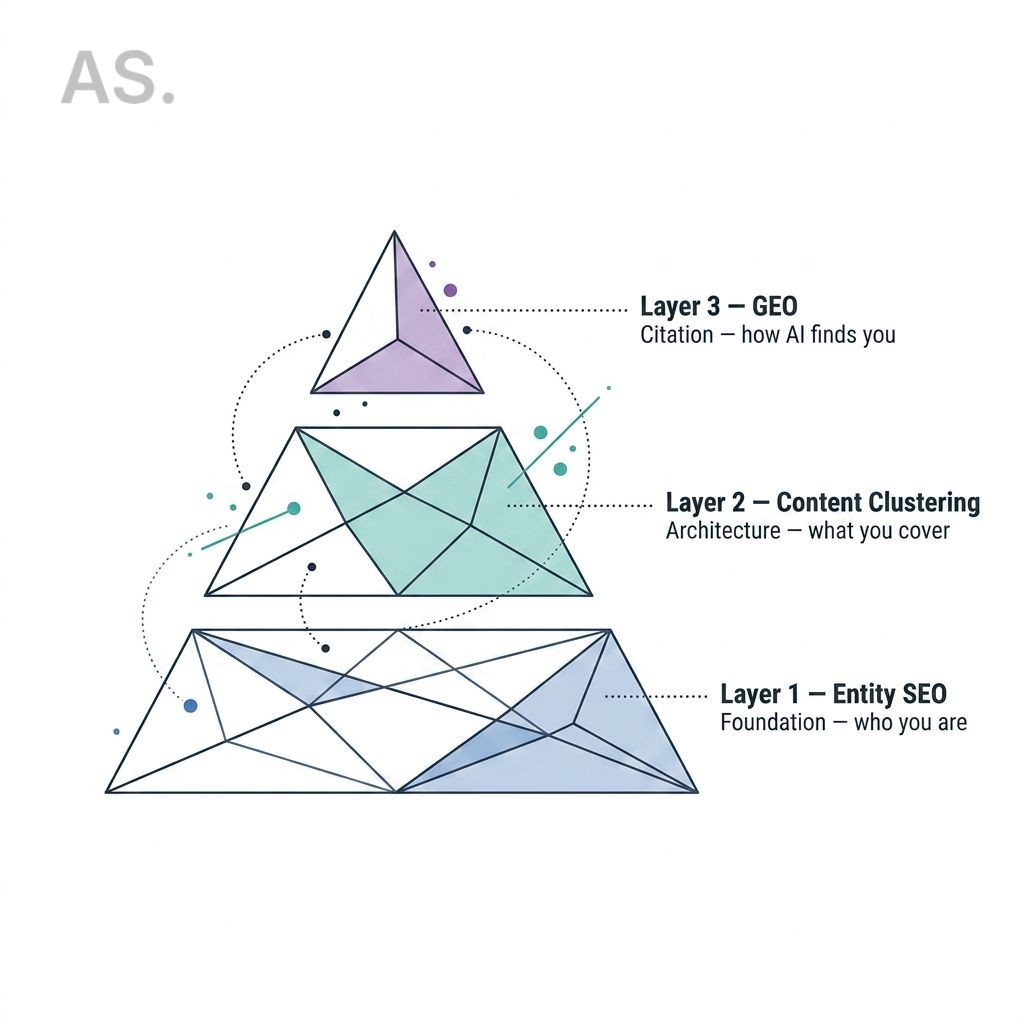
Everything in this guide sits inside a three-layer framework. Understanding the layers first makes every tactic below make sense as a system rather than a checklist.
Layer 1 — Entity SEO: Establishing your site, your name, and your niche as a known, trusted entity in your category. This is the foundation. Without it, everything built on top is fragile.
Layer 2 — Content Clustering: Building a structured library of interconnected content that covers your topic at depth — not a collection of isolated posts, but a deliberate architecture of pillar content and supporting cluster articles that signal comprehensive topical authority.
Layer 3 — GEO (Generative Engine Optimization): Structuring individual pages so that AI systems can extract, cite, and surface your content in AI-generated answers. This is the 2026 edge — most content creators aren't doing it deliberately yet.
Each layer depends on the one before it. Strong GEO without topical authority is a house on sand. A content cluster without entity signals is a library nobody can find. Build in order, and the compound effect is significant.
Layer 1: Entity SEO — Becoming a Reference in Your Niche
An entity, in Google's understanding, is a distinct, identifiable thing — a person, a business, a concept. Google's Knowledge Graph is essentially a map of entities and how they relate to each other. When Google and AI systems consider citing a source on a topic, they favour entities they've already connected to that topic consistently.
For a founder building a personal brand alongside a business, entity SEO means two things: your name as a person needs to be associated with your niche across multiple credible surfaces, and your website needs to demonstrate consistent, deep coverage of that niche over time.
Building your personal entity signal:
Your name should appear consistently across your website author bio, your LinkedIn profile, your Google Business Profile (if applicable), your YouTube channel, and any guest posts or media mentions. These don't need to be hundreds of mentions — they need to be consistent and clearly connected. The sameAs property in your JSON-LD author schema is how you formally signal to Google that Arpan Sharma on LinkedIn and Arpan Sharma on arpansharma.co are the same entity. This is the mechanism behind why author schema matters beyond just rich results.
Building your site's topical entity signal:
Google evaluates topical authority by looking at how comprehensively a site covers a given niche. A site with twelve interconnected posts on AI SEO — each covering a distinct sub-topic, all linking to each other, all written by the same named author — is treated very differently from a site with twelve disconnected posts across random topics. Depth and coherence are the signals.
For a practical framework on building and measuring topical authority on your site, read How to Build Topical Authority in SEO.
Layer 2: Content Clustering — The Architecture That Compounds
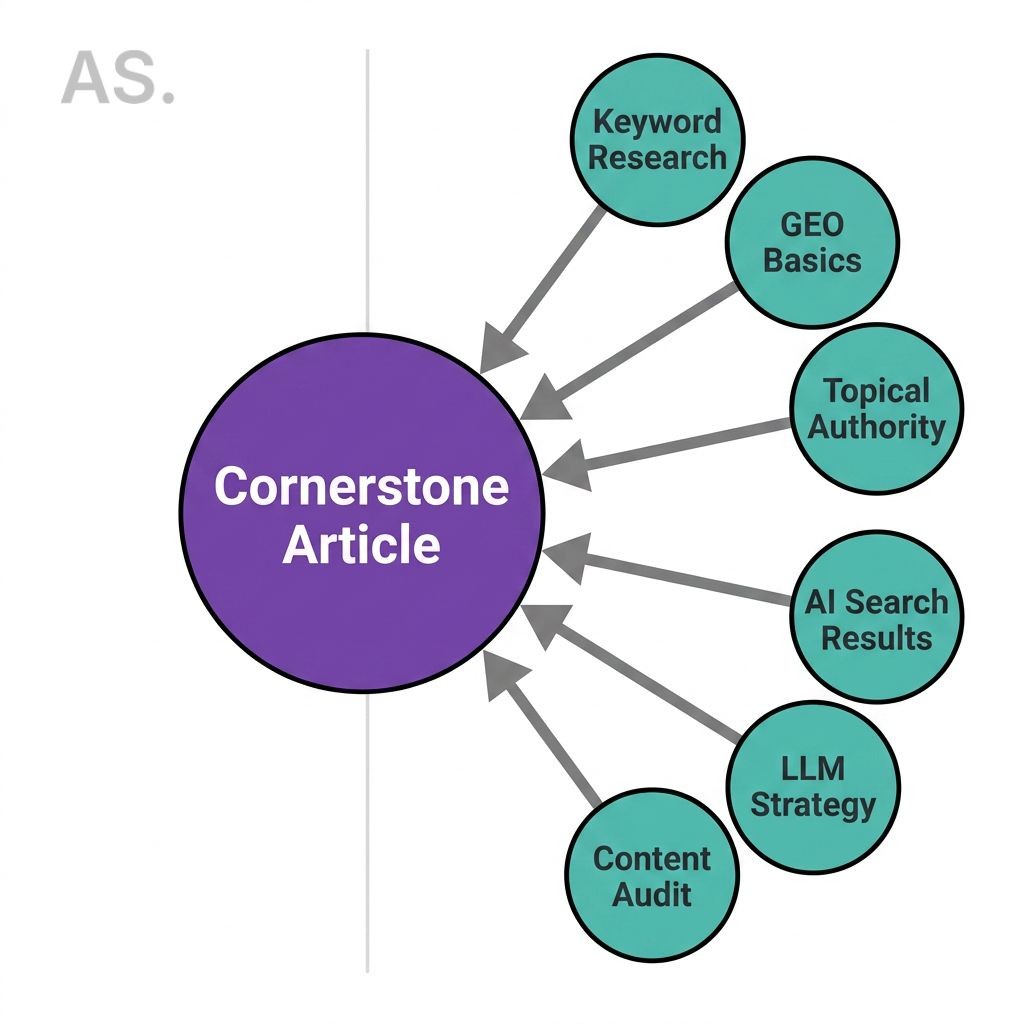
A content cluster is a deliberate structure: one comprehensive cornerstone article (the pillar) covering a broad topic at depth, surrounded by a set of supporting cluster posts covering specific sub-topics — each one linking back to the pillar, and the pillar linking out to all of them.
The mechanism is authority distribution. When an external site links to one of your cluster posts, some of that authority flows to the pillar through the internal link. When Google crawls the cluster, it sees a network of related content all pointing to a central reference — and interprets that as a signal that the pillar page is the authoritative resource on that topic. Over time, this architecture compounds: each new cluster post strengthens the pillar, and the pillar's strengthening authority raises the ranking floor for the whole cluster.
How to plan a cluster:
Start with your cornerstone topic — the broadest, highest-value question your audience asks. For this site: AI SEO for founders and small businesses. That's the pillar topic. Then map every specific question that sits inside that topic: how to do keyword research for AI search, what GEO means and how to implement it, how to build topical authority, how to rank in AI search results. Each of those becomes a cluster post.
The rule: cluster posts should answer one specific question with depth. The pillar should answer the broader question by connecting all the specific answers. Neither competes with the other — they reinforce each other.
Planning your keywords as clusters, not individual targets:
In 2026, keyword research is entity mapping. You're not looking for individual high-volume terms to target one post at a time — you're building a map of the conceptual territory your site needs to own. Every keyword you target should belong to a cluster. If it doesn't connect to an existing cluster, either it belongs in a new cluster or it's not a priority yet.
Use tools like Semrush's Keyword Gap report to identify topic areas your cluster is missing — queries your competitors are ranking for that you haven't addressed. For the full framework on researching and mapping keywords to clusters in the AI search era, read AI Keyword Research That Drives Leads.
Layer 3: GEO — Structuring Content to Be Cited by AI
Generative Engine Optimization is the practice of structuring your content so that AI systems — ChatGPT, Perplexity, Google AI Overviews, Claude — can extract, understand, and cite it accurately when answering relevant queries.
The fundamental insight behind GEO: AI language models don't browse websites the way humans do. They extract information from text that is clearly structured, directly stated, and semantically coherent. A paragraph that buries its key point in qualifications and caveats is harder to extract than a direct statement followed by supporting context. An FAQ section where each question maps to a clear, complete answer is extremely easy to cite. A page with proper heading hierarchy (H2 for sections, H3 for sub-points) gives AI systems a reliable map of the content.
The five GEO principles:
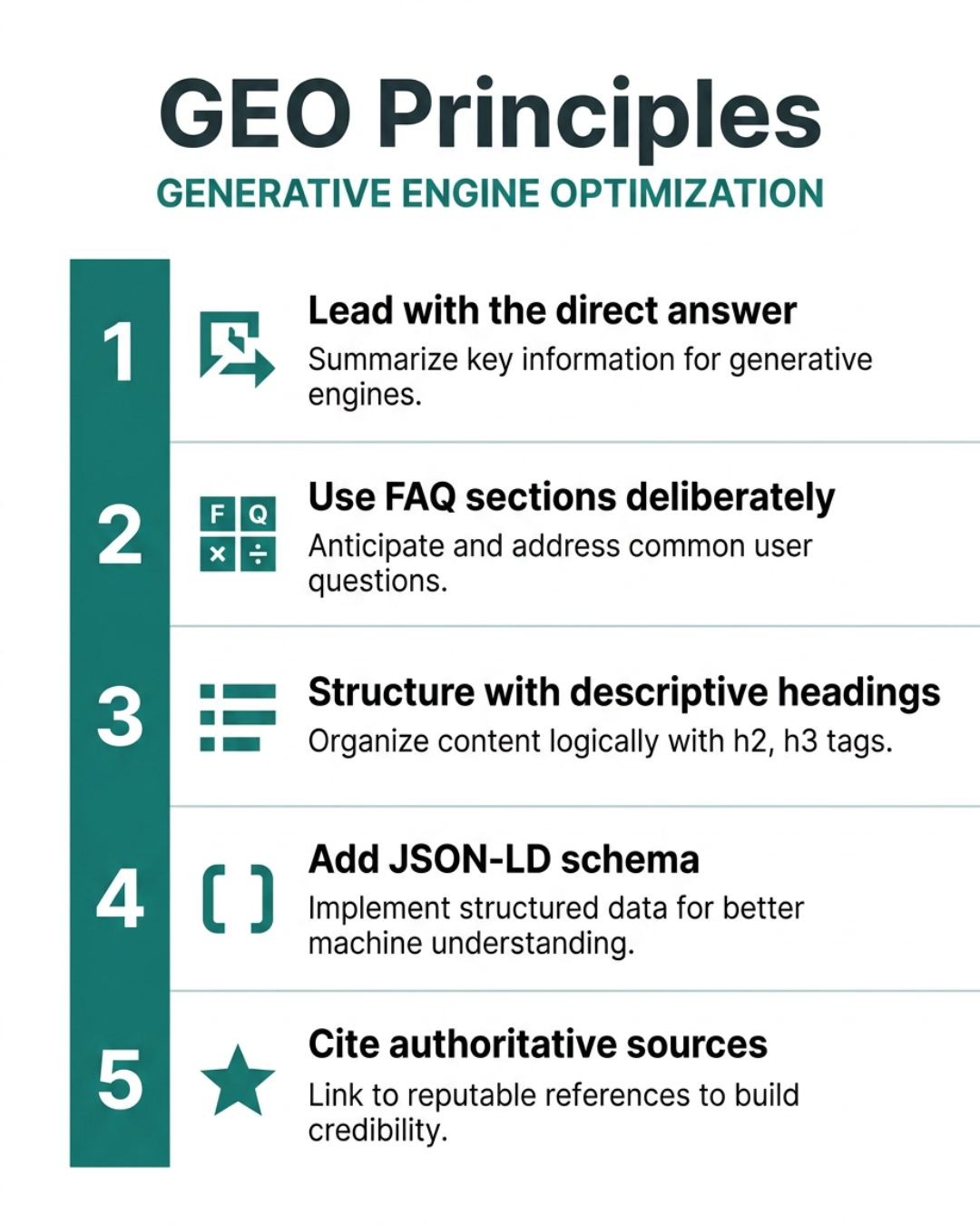
1. Lead with the direct answer. Every section of your content should open with a direct, quotable statement — the core answer to the question the section addresses. Supporting context, examples, and nuance follow. This is the inverse of how many writers approach prose, but it's exactly how AI systems extract information.
2. Use FAQ sections deliberately. A well-structured FAQ block at the bottom of every article — with real questions that match how people actually phrase their queries, each followed by a complete, self-contained answer — is one of the highest-value additions you can make to any piece of content. AI systems are trained to match questions to answers. Give them that structure explicitly.
3. Structure with headings, not just paragraphs. H2 headings should be descriptive enough to stand alone as a meaningful statement. "Why internal linking matters" is a better H2 than "Internal Links" — an AI system reading only the heading should be able to infer the section's content.
4. Add JSON-LD schema to every key page. Article schema with datePublished, author, and headline signals to Google that the page is a formal content piece with a named, credible author. FAQ schema on pages with Q&A sections enables rich results and reinforces the citation-friendly structure. This is a technical investment with an outsized return on AI visibility.
5. Cite authoritative sources. AI systems are trained to favour content that demonstrates awareness of the broader knowledge landscape. A page that cites Google's own documentation, references a peer-reviewed study, or links to an established authority is treated as more credible than an identical page that makes the same claims without any reference points.
If you want a ready-to-use system for implementing all five principles without starting from scratch, the GEO Citation Checklist & Prompt Pack gives you a structured checklist covering AI crawlability, schema, FAQ optimisation, entity clarity, and AI extractability — plus a curated set of prompts for ChatGPT, Claude, Perplexity, and Gemini. Available for ₹299 in the Olyfox shop.
For a full introduction to GEO as a discipline, read Generative Engine Optimization Basics Guide. For the specific tactics that get content cited in AI search results, read How to Rank in AI Search Results. For how this plays out specifically for founder-led businesses, read LLM SEO Strategy Explained for Founders.
The Tools Stack: What to Actually Use
You don't need twenty tools. You need four categories covered well.
Research and tracking: Google Search Console is non-negotiable and free. It tells you exactly which queries are bringing your pages impressions and clicks, which pages are indexed and which aren't, and where your Core Web Vitals need attention. Open it weekly. The Performance report — filtered by Pages, sorted by Impressions — will show you faster than any paid tool which cluster posts are getting traction. Use Google Search Console as your primary SEO dashboard before adding anything else.
Semrush (or Ahrefs) layers on top for competitive keyword research, tracking positions over time, and running the Keyword Gap analysis that reveals cluster opportunities. Mentioned by name because the specific features matter — Semrush's Topic Research and Keyword Clustering tools are directly built for the cluster-based approach this guide describes.
Content and structure: Your CMS handles publishing, but schema markup typically needs to be injected manually via custom code. For Framer users this means the Page Settings → Custom Code → End of <head> field for each post. The Structured Data documentation from Google Search Central is the canonical reference for building Article, FAQ, and BreadcrumbList schema correctly.
AI writing and research: ChatGPT and Claude are useful for drafting outlines, generating FAQ question sets, testing how an AI system would summarise your content, and identifying gaps in your cluster coverage. Perplexity is useful as a GEO audit tool — search your core topic on Perplexity and see whose content is being cited in the answer. If it's not yours, that's the benchmark you're working toward.
Automation: Zapier connects your blog's lead capture to your CRM, ensures new post notifications go out across channels automatically, and can trigger SEO task reminders as part of your monthly workflow. Build these workflows once, and your content system runs on lower ongoing maintenance.
For a deeper look at how these tools work together as a system, read AI SEO Tools and LLM Strategy.
How to Audit Your Existing Content in 30 Minutes
Before publishing a single new post, audit what you already have. Most sites have more ranking potential in their existing content than they realise — it just needs to be unlocked.
The 30-minute content audit:
Step 1 — Identify your high-impression, low-CTR pages (10 min). In Google Search Console, go to Performance → Search Results → Pages. Sort by Impressions. Look for pages with more than 500 impressions in the last 90 days but a CTR below 3%. These pages are ranking but not converting clicks. The fix is almost always the title tag or meta description — the SERP snippet isn't compelling enough. Update both to better match the search intent behind the queries bringing those impressions.
Step 2 — Find your position 4–20 keywords (10 min). In GSC, go to Performance → Queries. Filter by position 4–20. These are your quick-win keywords — pages already ranking well enough for Google to consider them relevant, but not yet in the top three where most clicks go. Export this list. Any page with a cluster of position 4–20 keywords is a priority for a content expansion pass — adding a new section, a more detailed FAQ, or a fresher example can push it into the top three within weeks.
Step 3 — Score your top 10 pages for thin content (10 min). Quickly scan your ten most-visited pages. For each one ask: Does this page fully answer the question someone searching for this would have? Does it have a structured FAQ? Does it link to related cluster posts? Does it have a clear, single conversion action? Any page that fails two or more of those checks is a priority for expansion.
This audit process is the foundation of the AI SEO Content Audit Template in the Olyfox shop — a structured scoresheet that runs every page on your site through a systematic review, prioritises your fixes, and tracks improvement over time. For the principles behind what makes content thin and how to fix it, read 5 SEO Mistakes Small Businesses Make.
The 90-Day AI SEO Roadmap for Founders
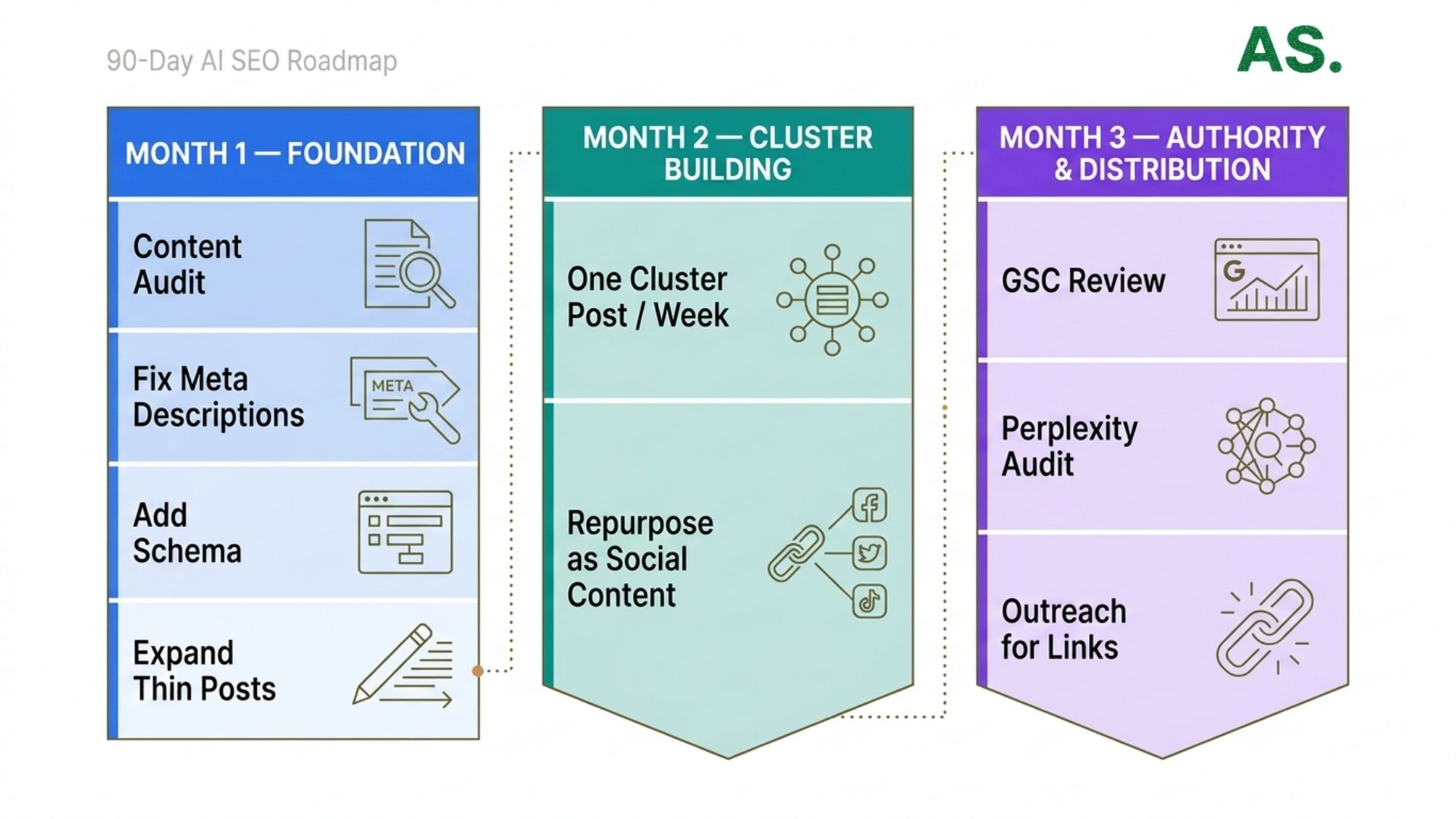
SEO rewards consistency over intensity. A 90-day structured plan beats six months of sporadic effort every time. Here's how to sequence the work:
Month 1 — Foundation
The first month is about fixing before building. No new content until the foundation is solid.
Week 1–2: Run the 30-minute content audit above. Fix every meta description. Update your top five posts to link to your cornerstone article. Add Article and FAQ schema to your three highest-traffic posts.
Week 3–4: Expand your two thinnest posts — the ones most likely to rank but currently too light to hold position. Add 500–800 words of depth, a proper FAQ section, and at least one new internal link per post. Publish this cornerstone article.
Month 2 — Cluster Building
With the foundation repaired, Month 2 is about filling the gaps in your cluster.
Write one new cluster post per week targeting a specific sub-topic that your keyword research identified as missing. Each post: 1,000–1,500 words, structured with H2s, a FAQ section, Article schema, and at least one link to this cornerstone. Repurpose each post as a Twitter thread within 48 hours of publishing, and as a LinkedIn carousel within the same week.
Month 3 — Authority and Distribution
Month 3 is about amplifying what's working and compounding topical authority.
Review GSC weekly: which of your Month 2 posts are getting early impressions? Expand those first — Google has already signalled they're relevant. Run a Perplexity search on your core topic: who's being cited? If competitors are appearing and you're not, study their structure and GEO implementation.
Begin outreach for one or two genuine mentions or links per month — not mass link-building, but targeted relationship-based placements on sites your audience actually reads.
The full 90-day system with weekly task breakdowns, a keyword cluster planner, and KPI tracking dashboards is available as the 90-Day AI SEO Roadmap in the Olyfox shop — built as a Notion workspace you can duplicate and adapt to your specific content plan.
3 Mistakes Founders Make That Kill Their SEO Results
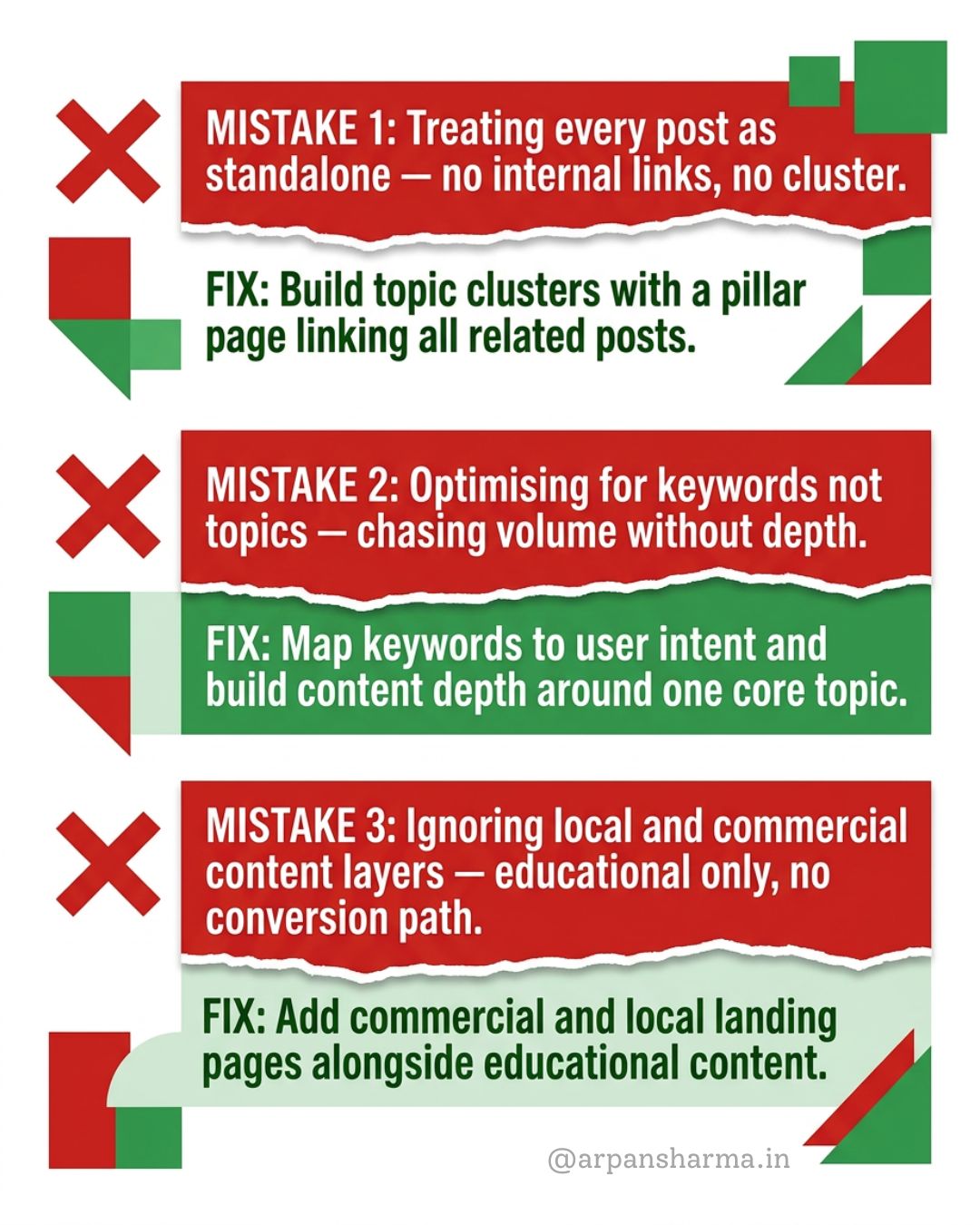
After auditing dozens of founder blogs, the same three problems appear repeatedly.
Mistake 1: Treating every post as standalone content. The most common failure. Posts get published with no internal links, no connection to a cluster, and no relationship to a cornerstone. Each one competes independently rather than compounding together. The fix is retrospective: go back to every existing post and add at least two internal links — one to the cornerstone, one to a related cluster post. Then build this habit into every future post before it publishes.
Mistake 2: Optimising for keywords instead of topics. Founders often chase individual high-volume keywords without building the topical coverage that makes those keywords achievable. Google doesn't rank isolated pages highly on competitive topics — it ranks sites that have demonstrated comprehensive, trustworthy coverage of the topic over time. The fix: before targeting a new keyword, ask whether you have three to five related posts that establish your authority on the surrounding topic. If not, build those first.
Mistake 3: Ignoring the local and commercial layers. Many founder blogs focus entirely on educational content — how-to guides, explainers, frameworks — and neglect the commercial and local layers that connect SEO visibility to actual revenue. Educational content builds authority. Commercial content (case studies, service pages, comparison posts) converts that authority into enquiries. Local content (city-specific posts, local SEO tactics) captures high-intent searches from the geographic audiences most likely to hire you. All three layers belong in a complete content system. The local layer is covered in detail in Local SEO and Marketing Tips for Service-Based Businesses.
Connecting SEO to Revenue: The Conversion Layer
SEO without a conversion architecture is a traffic source with no destination. The full system closes the loop between visibility and revenue.
Every piece of content in your cluster should have a clearly mapped conversion path:
Educational posts (how-to guides, frameworks, explainers) → inline CTA to a relevant lead magnet or low-cost digital product → email follow-up sequence → service enquiry. If you need a ready-made lead magnet to anchor this step, the AI SEO Content Audit Template is built for exactly that purpose.
Commercial posts (case studies, service comparisons, results breakdowns) → direct CTA to a discovery call or service page.
Local posts (city-specific guides, local service pages) → Google Business Profile + direct call or contact form submission.
The paid traffic layer connects to this the moment your organic SEO starts building warm awareness. A visitor who has read three of your blog posts before clicking a retargeting ad converts at a fundamentally different rate than cold traffic. Read How to Reduce Your Ad Costs Without Losing Conversions for how to build that paid layer efficiently once your organic foundation is established.
Your landing pages are the final gate between interest and action. Every conversion-focused page in your content system should follow the ten-element framework in High-Converting Landing Page Structure — because the best SEO in the world underperforms when traffic lands on a page that isn't built to convert.
What to Do Next
The system described in this guide doesn't need to be built all at once. It needs to be built in order.
This week: Run the 30-minute audit above on your existing content. Fix your meta descriptions. Identify your cornerstone topic and link to your cornerstone post from every existing article on your site.
This month: Write or expand one cluster post. Add schema to your top three posts. Set up GSC if you haven't already.
This quarter: Work through Month 1 of the 90-day roadmap. Write and publish your cornerstone article. Build out the conversion layer — a lead magnet, a low-cost entry product, or a direct service CTA — so the traffic you're building has somewhere to go. The 90-Day AI SEO Roadmap gives you the full Notion dashboard to run this systematically.
If you'd rather have an expert build the system alongside you, Olyfox's AI SEO & Generative Engine Optimization service covers everything from technical foundation to content cluster planning to GEO implementation — built specifically for founders and small businesses who want results without the agency overhead.
FAQ
What is the difference between SEO and GEO (Generative Engine Optimization)?
Traditional SEO focuses on ranking pages in Google's organic results by optimising for keywords, backlinks, and technical signals. GEO focuses specifically on structuring content so that AI systems — including Google AI Overviews, ChatGPT, and Perplexity — can extract, understand, and cite your content in AI-generated answers. In 2026, both matter: SEO drives discovery through traditional search, GEO drives citation in AI answers. A complete strategy addresses both simultaneously.
How long does it take to see results from a content cluster?
Early signals — impressions and click-through rate improvements — typically appear within 4–8 weeks of publishing well-structured content. Meaningful ranking improvements on competitive terms take 3–6 months of consistent cluster building. The compounding effect accelerates after month 3, when you have enough interconnected content for Google to clearly identify your site's topical authority. Fixing existing content (meta descriptions, internal links, thin content) can show results within 2–4 weeks.
How many posts do I need to build topical authority in a niche?
There's no fixed number, but a functional cluster requires a minimum of one cornerstone post and four to six supporting cluster posts covering distinct sub-topics. Competitive niches may require ten or more cluster posts before topical authority is strong enough to rank the cornerstone on challenging keywords. Depth and interconnection matter more than raw post count — ten well-linked, comprehensive posts outperform thirty thin, isolated ones.
Does social media help with AI SEO?
Not directly. Social media platforms don't provide backlinks that pass authority, and social signals are not a confirmed ranking factor. However, social distribution drives direct traffic, which can indirectly improve engagement signals, and wider distribution increases the chance of organic backlinks from people who discover your content via social. More importantly, social repurposing of your content — Twitter threads, LinkedIn carousels — extends the reach of each article to audiences who may later search for your brand directly, which is a positive entity signal.
What schema markup should every blog post have?
At minimum: BlogPosting (or Article) schema with headline, datePublished, dateModified, author (including sameAs links to your social profiles), and image. Add FAQPage schema to any post with a structured FAQ section. Add BreadcrumbList schema to establish page hierarchy. These three schema types together cover the core signals that help both Google rich results and AI systems accurately classify and cite your content.
Do I need backlinks if my content cluster is strong?
Backlinks remain a meaningful ranking signal, particularly for competitive keywords. A strong content cluster without any backlinks will rank well for lower-competition long-tail queries, but will struggle to compete for high-volume head terms. Think of backlinks as amplifying your cluster authority rather than replacing it. The cluster is the foundation; backlinks accelerate the compound effect of that foundation.
The tools to implement this system are available in the Olyfox shop — including the AI SEO Content Audit Template and the 90-Day AI SEO Roadmap Notion dashboard. If you want the system built for your specific site and niche, the AI SEO & GEO service is where to start.