[ News and Blog ]
7 essential services every digital marketing business in India must offer for measurable growth
|
Small Business

Arpan Sharma
AI Search & Marketing Systems
If you run a digital marketing business in India, or you are a founder evaluating agencies to partner with, you already know the core problem: India has thousands of digital marketing agencies operating today, estimates range from 5,000 to upwards of 10,000 depending on how broadly you define the category, yet a significant number of founders and small business owners still find themselves paying retainers for three, six, sometimes twelve months and walking away with nothing they can trace to revenue. The gap between what agencies promise and what they actually deliver in measurable outcomes is the exact problem this article is built to close.
Over the past several years, working with founders across sectors ranging from SaaS startups in Bengaluru to ecommerce brands in Delhi NCR, I have seen the same pattern repeat itself at Olyfox. Many agencies oversell on decks and underdeliver on attribution. They optimise for activity, not outcomes. The result is founders who are spending money but genuinely cannot tell you whether their agency is contributing to pipeline or just filling a calendar.
This article will not give you a list of agency names to Google. Instead, it gives you the service-level criteria that separate capable agencies from expensive noise, concrete pricing benchmarks so you can calibrate your budget, and a practical shortlisting and onboarding framework you can apply immediately. By the end, you will know exactly what to ask, what to pay, and what to expect in the first 90 days.
Why most digital marketing agencies in India miss on measurable growth
India's digital marketing market reached approximately USD 5.15 billion in 2024 and is growing at over 30% CAGR, according to multiple industry forecasts. That kind of growth rate attracts supply fast, and quality control rarely keeps pace. The result is a market where anyone with a Canva account and a GSuite login can call themselves a full-service agency, the barriers to entry are low, and the consequences of that show up in client results.
The vanity metrics trap that wastes marketing budgets
The most common agency failure mode is not fraud; it is misalignment on what "results" means. Agencies report on impressions, reach, follower growth, and keyword rankings in isolation because those numbers are easy to move and hard to dispute. A founder paying ₹40,000 per month for social media management, a figure that sits squarely in the mid-tier range for this service, with no lead-tracking in place has no idea whether any of that spend is generating pipeline. The agency looks busy. The dashboard looks green. Revenue stays flat.
The fix is simple but non-negotiable: every service an agency manages must connect to a measurable business output. That means leads generated, cost per acquisition, qualified traffic with conversion tracking, or revenue attributed by channel. If your agency cannot show you that chain clearly, the relationship is built on activity, not accountability.
What "full-service" actually means, and what it usually doesn't
The term "full-service" has lost almost all meaning in the Indian agency market. Many agencies that use it are either quietly outsourcing core functions like technical SEO and marketing automation, or they have one generalist handling five different channels with no real depth in any of them. A genuinely capable agency has in-house specialists for each service area, not one team lead who "oversees" contractors across every discipline.
Before signing anything, ask specifically who handles your account daily, what their background is in that service, and how many accounts they currently manage. That one question reveals more about delivery quality than any pitch deck ever will.
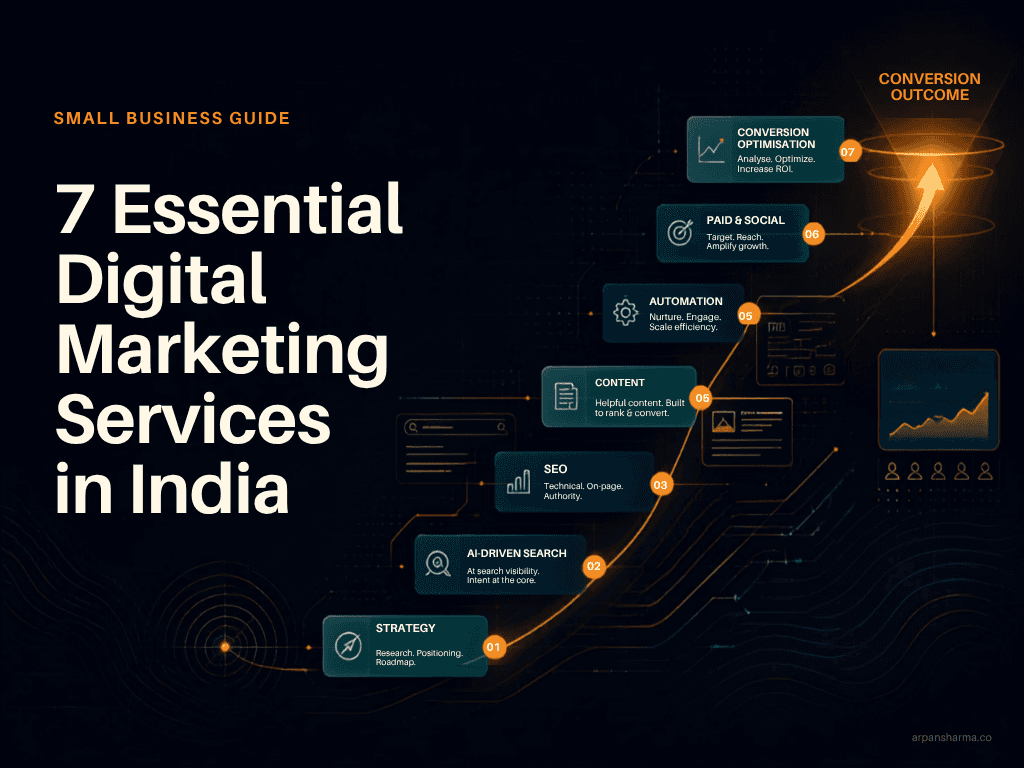
The seven services a capable digital marketing partner must bring
Every agency will claim to offer all of these. What matters is whether they can show you how each one connects to your business outcomes, not just what they deliver as a task.
Services 1, 3: AI-driven SEO, content systems, and marketing automation
AI-driven SEO strategy is no longer optional for any serious digital marketing business in India. Traditional keyword ranking is still relevant, but the search landscape in 2026 includes Google's AI Overviews, Perplexity, and other generative surfaces that pull citations directly from authoritative content. A capable agency should be building topical authority that gets your brand cited in AI-generated answers, not just ranked on page one. This requires a content architecture built around subject-matter depth, not individual keyword targets.
Content systems are distinct from content posting. A strong agency shows you how each piece of content compounds over time, building authority in a topic cluster that feeds organic traffic for months or years. The alternative is a content calendar that fills up your blog and generates zero commercial intent traffic. Ask any agency you evaluate: what is the compounding mechanism here, and how do you track it?
Marketing automation is where many agencies either skip the brief entirely or offer a basic email drip that does not actually nurture leads. Mature automation means behavioural triggers tied to user actions on your site, lead scoring that tells your sales team which prospects are ready to buy, and CRM integration that connects marketing activity to revenue in one clean pipeline view. Entry-level automation is better than nothing. But if an agency cannot show you a logic map of how a cold visitor becomes a qualified lead through their system, you are not getting automation, you are getting scheduled emails.
Services 4, 7: Performance marketing, social, CRO, and analytics
Performance marketing means the agency manages your ad spend with clear ROAS targets and takes accountability for them, not just "optimises campaigns" as a vague ongoing task. Ask any agency what ROAS they are targeting for your budget and what they do if the account falls below it. Silence or deflection is a red flag. A credible performance agency will have a structured testing and iteration process they can walk you through.
Social media management should connect to conversion pathways, not just content posting. Every social channel should have a clear role in your funnel: awareness, retargeting, community trust, or direct response. If an agency cannot articulate that role for your specific business and audience, they are running a content factory, not a growth system.
Conversion rate optimisation (CRO) is one of the most commonly skipped services among performance marketing companies in India and arguably the highest-leverage one. Getting more traffic is expensive. Getting more revenue from the traffic you already have is a multiplier. CRO covers landing page testing, UX improvements, form optimisation, and copy testing. Any agency claiming to drive growth without CRO in the mix is leaving significant revenue on the table.
Analytics and attribution is non-negotiable. Clean reporting that shows which channel drove which lead or sale is the foundation everything else is built on. Without it, you cannot make a single rational decision about where to increase or cut budget. A capable agency sets up attribution from day one, not as an afterthought six months in.
Digital marketing agency pricing in India: what credible agencies actually charge
Pricing across digital marketing services in India varies enormously, and that range is not random. It generally reflects scope, seniority, and execution depth. Knowing the benchmarks prevents you from either overpaying for average work or underpaying and wondering why results never arrive.
Monthly retainer benchmarks by service type
The following ranges reflect realistic 2026 market rates across top digital marketing companies in India. They are drawn from agency pricing surveys and market guides and give you a calibration framework rather than a fixed tariff:
SEO retainers:₹8,000 to ₹2,00,000 or more per month depending on competition and scope. Serious mid-tier SEO work for competitive categories typically starts around ₹40,000 to ₹1,20,000 monthly.
PPC and Google Ads management:₹10,000 to ₹3,00,000 plus ad spend.
Social media management:₹8,000 to ₹2,00,000 monthly.
Performance marketing retainers:₹15,000 to ₹2,50,000 or more.
Full-service or ecommerce engagements:₹50,000 to ₹5,00,000 monthly, sometimes higher for D2C brands with complex catalogue requirements.
A founder spending ₹15,000 per month on SEO is in entry-level territory. At that price, expect basic on-page work and limited content output. If you are competing in a category with established players, that budget will not move the needle on organic visibility within any reasonable timeframe.
The three pricing models and which one works best for you
A fixed monthly retainer is the most common model and works well when scope is clearly documented. Without a scope document, retainers quietly expand in effort while the agency resists taking on more work. A percentage of ad spend, typically 8 to 20 percent, is standard for PPC and paid social. It aligns incentives up to a point, but watch for agencies that inflate spend to increase their fee. A performance-based or hybrid model, meaning a base fee plus an outcome-linked bonus, offers the strongest incentive alignment and is worth seeking out, though genuine performance-based agencies are rarer than the market suggests. Project-based pricing works best for audits, account migrations, and one-time campaign builds.
The red flag to watch for: agencies quoting 30 to 50 percent below market rates while promising enterprise-level results. The economics of quality execution do not work at those price points, and you will find out why within the first two months of a retainer.
How Arpan Sharma's compounding growth framework works in practice
Most agencies sell services as separate line items. SEO is one engagement. Automation is another. Paid media is a third. The problem with that structure is that none of those services are actually independent. Each one either amplifies or undermines the others, and when they are managed separately, you get fragmented reporting, misaligned priorities, and compounding inefficiency rather than compounding growth.
How SEO, automation, and content connect into a single system
The framework Arpan Sharma and the Olyfox team use is built on a straightforward but consequential logic: organic content builds topical authority and drives consistent inbound traffic; automation captures and nurtures that traffic into qualified leads without requiring constant manual effort; and performance marketing is then used to amplify what is already working organically, rather than subsidising weak foundations with paid spend.
That sequence matters. Running paid media without organic credibility means you are renting attention. Running content without automation means you are generating traffic you cannot capture. The system only compounds when all three layers are active and connected, and that connected execution is precisely what separates Arpan Sharma's approach from the fragmented agency model most founders have already experienced.
A short client example from Olyfox
One SaaS startup we worked with was spending approximately 70 percent of their marketing budget on paid ads to maintain a pipeline that covered only a fraction of their growth targets. Organic visibility was essentially zero. Over a seven-month engagement, we built out a topic cluster targeting the specific buyer questions driving their category, connected that content to a lead-nurturing sequence through their CRM, and restructured their paid media to retarget warm organic visitors rather than cold audiences. The outcome, drawn from our internal client records, was a 3.4x increase in organic-led leads, a 40 percent reduction in customer acquisition cost, and paid ad spend redirected from broad awareness to high-intent retargeting where ROAS was measurably higher. That is what a connected system looks like in practice, as opposed to three separate agency invoices producing three separate dashboards that nobody correlates.
How to shortlist, brief, and onboard the right digital marketing business in India: a practical checklist
With thousands of agencies operating across the country, shortlisting requires filters, not browsing. Here are the five that consistently separate capable digital marketing services in India from the rest.
Five filters to narrow your shortlist fast
Industry experience:Has the agency run campaigns in your specific category? Sector-specific learning curves are real and expensive when an agency is learning them on your budget.
Service depth vs. breadth:Do they have dedicated in-house specialists for the services you need, or are they outsourcing key execution to freelancers?
Proof of results:Can they show attribution-linked outcomes, leads, CAC, ROAS, revenue impact, rather than rankings or follower counts?
Account ownership:Who manages your account daily? Ask for that person's name, background, and current client load before you sign.
Pricing transparency:Do they quote clearly by service and scope, or do pricing conversations stay vague until you are close to signing?
A 30-60-90 day onboarding roadmap
Days 1, 30: The agency should complete a full audit covering SEO, paid accounts, analytics, and existing content; establish baseline metrics across every channel they manage; and get a written strategy document signed off by you before any execution begins. If an agency skips the audit and jumps straight to posting or running ads, that is a sign of template-driven work, not a custom strategy built around your business.
Days 31, 60: Expect the first content and SEO outputs to go live, automation sequences to be built and tested in your CRM, and ad accounts to be restructured according to the agreed strategy rather than simply inherited and continued.
Days 61, 90: The first performance review against the KPIs you agreed on at the start, iteration based on what the data shows, and a clear roadmap for the following quarter. That 90-day structure gives you three natural checkpoints to assess whether the relationship is producing what was promised, with enough time for genuine results to emerge but not so long that you are locked in without evidence.
The decision that actually moves revenue
A digital marketing business in India that delivers measurable growth is not the one with the longest client list or the most recognisable name on a roster. It is the one that operates the right service mix as a connected system, where SEO feeds automation, content builds authority, and performance marketing amplifies what is already earning traction organically. That distinction is the difference between paying for activity and paying for growth.
The pricing benchmarks, shortlisting filters, and onboarding framework in this article give you a practical foundation for making that evaluation with confidence. Use the five filters before any discovery call. Use the 30-60-90 roadmap to set expectations before any contract is signed. And demand attribution-linked KPIs from day one, not impressions and follower counts dressed up in a branded PDF.
If you want to see how Arpan Sharma and the Olyfox team apply this compounding growth framework to your specific business, the next step is a focused discovery conversation. No pitch deck, no pressure, just a direct assessment of where your current marketing system has gaps and what a connected strategy would look like for your category and stage. Get in touch to book that conversation.
Also Read: The Complete AI SEO System for Founders: Content, Citations & Conversions